
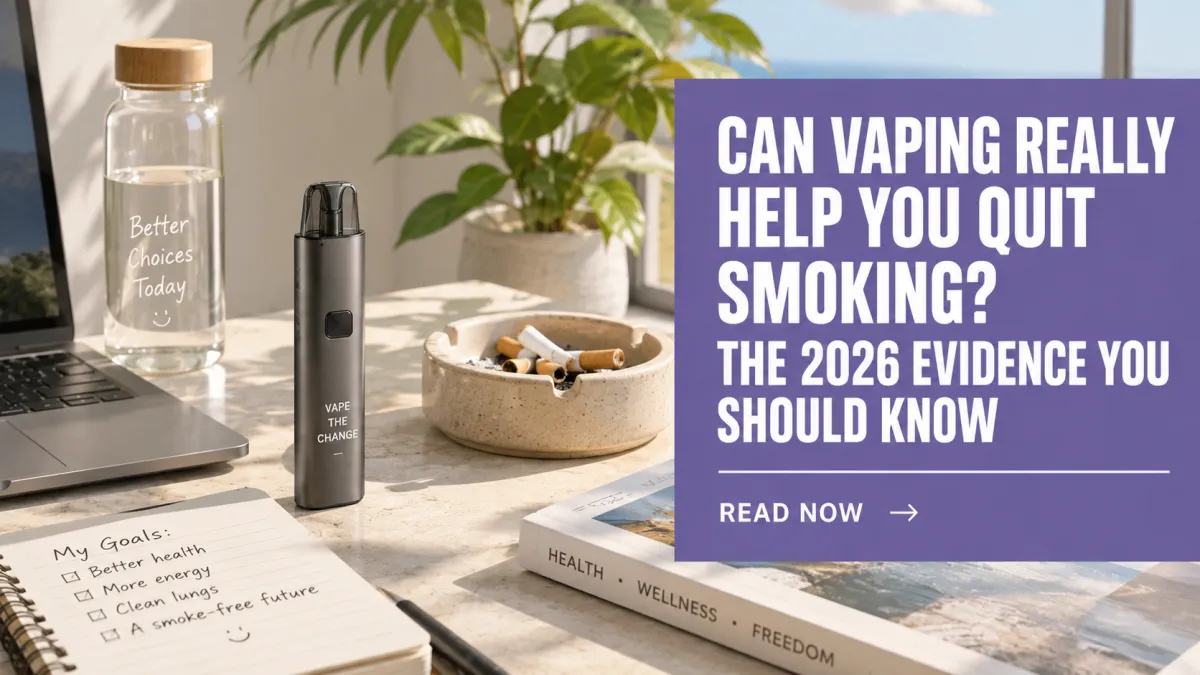
Can Vaping Really Help You Quit Smoking? The 2026 Evidence You Should Know
If you smoke cigarettes and have considered vaping as a way to quit, you've probably heard two very different opinions.
Some people say vaping helped them finally stop smoking. Others argue that it simply replaces one nicotine habit with another.
So, what does the research actually say?
The latest evidence gives us a more nuanced answer: for adults who smoke, nicotine e-cigarettes can help more people quit smoking than traditional nicotine replacement therapy (NRT), such as patches or gum. But vaping is not risk-free, and quitting cigarettes does not necessarily mean immediately quitting nicotine altogether.
What Does the Latest Cochrane Review Say?
The strongest evidence comes from the latest update of the Cochrane living systematic review on electronic cigarettes for smoking cessation, published on August 26, 2026.
The review included 80 studies involving 29,861 adults who smoked. It looked specifically at whether e-cigarettes could help people stop smoking and what unwanted effects were reported. The evidence was current through January 1, 2026.
The most important comparison was between nicotine e-cigarettes and nicotine replacement therapy (NRT).
Cochrane found:
High-certainty evidence that nicotine e-cigarettes increase smoking cessation compared with NRT.
The relative risk (RR) was 1.59 (95% CI 1.30–1.93).
In absolute terms, this could mean approximately 4 additional people quitting for every 100 people using nicotine e-cigarettes rather than NRT (95% CI: 2 to 6 additional quitters).
The comparison came from 7 studies involving 2,544 participants.
Put simply, the evidence does not say that vaping guarantees a person will quit smoking. It says that, in the trials reviewed, nicotine e-cigarettes produced higher quit rates than NRT.
Cochrane's plain-language estimate suggests that for every 100 people trying to quit, around 8–10 may successfully stop smoking with nicotine e-cigarettes, compared with around 6 using NRT. These are estimates, not a guarantee for any individual.
What About Vaping Without Nicotine?
The comparison becomes less certain when nicotine and non-nicotine e-cigarettes are compared.
Cochrane found moderate-certainty evidence that nicotine e-cigarettes probably result in higher quit rates than e-cigarettes without nicotine.
The relative risk was 1.46 (95% CI 1.09–1.96), based on 6 studies involving 1,613 participants.
In absolute terms, this could mean approximately 3 additional quitters per 100 people, with an estimated range of 1 to 7 additional quitters.
So nicotine appears to matter when vaping is being used as a smoking-cessation tool.
But Is Vaping Actually Safe?
This is where the conversation needs some balance.
The Cochrane review supports the effectiveness of nicotine e-cigarettes for smoking cessation, but that does not mean vaping is harmless.
The review found that non-serious unwanted effects were more common with nicotine e-cigarettes than with behavioural support or no support, although the evidence was less certain when comparing them with NRT. Commonly reported problems can include things such as throat or mouth irritation, headache, coughing and nausea. Serious adverse events were uncommon in the studies, but the evidence was not strong enough to establish whether their rates differ between treatments.
There is also an important limitation: long-term health effects remain uncertain.
That means “better for quitting cigarettes” should not be interpreted as “healthy” or “risk-free.”
The practical distinction is important:
Smoking cigarettes involves burning tobacco and producing smoke. Vaping does not involve combustion, but it still exposes the user to nicotine and other substances.
For someone who already smokes, completely replacing cigarettes with vaping may reduce exposure to some harmful substances compared with continuing to smoke. But that does not make vaping equivalent to not using nicotine at all.
What If You End Up Vaping Instead of Smoking?
This is one of the most interesting parts of the evidence.
A separate systematic review led by researchers at the University of Oxford looked specifically at longer-term e-cigarette use among people who received e-cigarettes as a smoking-cessation aid.
It included 19 studies involving 7,787 participants.
Among people assigned to e-cigarette conditions, 54% were still using e-cigarettes at six months or longer (95% CI: 46%–61%). Among participants who had successfully quit combustible cigarettes, the proportion still using e-cigarettes was higher: 70% (95% CI: 53%–82%).
This is not evidence from the 2026 Cochrane update itself. It comes from a separate 2022 systematic review.
And it is worth interpreting carefully.
Continuing to vape after stopping cigarettes may mean someone has successfully moved away from smoking but has not yet stopped nicotine use. Whether that is a temporary step, a long-term pattern, or something that varies greatly between individuals remains an important area for research.
So, if the goal is to stop smoking, the first major milestone is stopping combustible cigarettes. What happens with nicotine afterwards can be a separate part of the journey.
The Biggest Mistake: Thinking Dual Use Is the Same as Quitting
One thing should not get lost in all the statistics:
Switching from cigarettes to vaping is different from using both cigarettes and a vape indefinitely.
If someone starts vaping but continues smoking regularly, they have not achieved the same outcome as someone who completely stops smoking.
The 2026 Cochrane review is specifically about smoking cessation. Its findings should therefore not be used to suggest that simply adding vaping to an existing smoking habit produces the same benefit as quitting cigarettes.
If vaping is being used as a smoking-cessation strategy, the meaningful target is moving away from combustible cigarettes rather than maintaining two habits indefinitely.
So, Can Vaping Help You Quit Smoking?
Based on the latest Cochrane evidence, yes, for adults who smoke, nicotine e-cigarettes can be an effective smoking-cessation option.
The evidence is particularly strong when nicotine e-cigarettes are compared with NRT: Cochrane rated that evidence as high certainty, with an estimated 4 additional quitters per 100 people compared with NRT.
But there are several important caveats:
Vaping is not risk-free.
The evidence applies to people who already smoke, not people who have never smoked.
The research does not mean every vape product will produce the same results.
Continuing to smoke while vaping is not equivalent to successfully quitting smoking.
Long-term vaping and long-term nicotine use still require further research.
Quitting cigarettes and quitting nicotine are not necessarily the same step.
And that last point is probably the most useful way to look at the evidence.
Vaping may be a tool for moving away from smoking. It should not be confused with a claim that vaping itself is harmless.
What Does This Mean for Someone Trying to Quit?
If you're currently a smoker and considering vaping, the evidence suggests that nicotine e-cigarettes are worth considering as one possible cessation approach.
But the goal should remain clear: get away from combustible cigarettes.
From there, some people may eventually reduce their nicotine intake or stop vaping altogether. Others may continue using nicotine for longer. The evidence does not give us one universal timeline that works for everyone.
Personally, I think this is where the conversation around vaping becomes more useful when we stop treating it as simply “good” or “bad.” The more important question is what is someone using it for, and what is happening to their cigarette consumption as a result?
For an adult smoker, completely moving away from cigarettes is a much more meaningful outcome than simply changing the device in their hand.
Cstyle Indonesia: Practical Support for Your Vape Journey
If you're an adult smoker exploring vaping as part of your effort to move away from cigarettes, Cstyle Indonesia can be a practical place to learn about different devices, nicotine options and vaping basics.
Our role is simple: helping customers understand products and choose something that fits their needs. We are not a medical provider, and vaping should not be treated as medical treatment.
You can visit a Cstyle store, speak with our team, test available products where offered, and explore our educational guides before making a decision.

If you're in Bali, you can also visit Cstyle locations in Ubud or Uluwatu, or check the nearest store through our store directory.
For more practical vaping guides, product information and updates, follow Cstyle Indonesia and explore our blog.
The Bottom Line
The 2026 Cochrane evidence makes one thing clearer: nicotine e-cigarettes can help adults who smoke quit cigarettes, and they appear more effective than NRT in the evidence reviewed. The finding is supported by high-certainty evidence, with an estimated 4 additional quitters per 100 compared with NRT.
But that does not make vaping harmless, and it does not mean every vape product or every vaping pattern will produce the same result.
The most important distinction is simple:
If vaping helps a smoker stop smoking completely, that is a meaningful change. But vaping should be viewed as a potential smoking-cessation tool not as a risk-free habit.
Last Updated: September 2026
Disclaimer: This article is for general educational purposes and is not medical advice. If you are pregnant, have an existing medical condition, take medication, or are unsure which smoking-cessation approach is appropriate for you, speak with a qualified healthcare professional.

About Us
Welcome to Bali’s top vape shop!
Since 2014, we’ve been dedicated to quality and exceptional service, growing to seven locations across the island.
Our focus is on offering premium products and personalized guidance, ensuring every visit is a great experience.
Discover why we’re Bali’s most visited vape shop.
Follow Us On Social Media
Quick Links
Contact Us
Jalan Raya Kerobokan no. 117 A, Kuta Utara, Bali 80361
(+62) 819 1625 8130

Copyright© 2026 CSTYLE - All Rights Reserved.
Website powered by NEO SMART SOLUTION

Facebook
Instagram
TikTok
Youtube